
The Equalizer® system lets players of any skill level compete against each other evenly.
With The Equalizer®, it’s feasible for a beginner to have a nearly equal chance in a match against a more highly skilled player. The Equalizer® aids the lesser skilled player by dictating mathematically that he/she needs to win fewer games or points than his opponent to win the match. (In golf and bowling, you give or get strokes or pins.)
Everyone Can Play – Anyone Can Win!® – The Equalizer® is only available in the APA.
In an APA League, you give or get games in the 8-Ball format and you give or get points in the 9-Ball format. How many games or points you give or get is determined by comparing your skill level to your opponent’s skill level. A higher skilled player must give games or points to a lower-skilled player, thus evening the match.
Using The Equalizer® in 8-Ball
How Handicaps are Determined
How to Get Started
New players do not have a skill level established, so all new players will start as a skill level 3. A League Operator is authorized to assign special skill levels and lowest attainables to new players who are known to be highly skilled players or to players who have previously established a skill level in another format. As a result of your first match, a skill level is established and reported for you. It is against the rules for a player who has an established skill level to attempt to reestablish his skill level at a later time. For example, you can’t quit for awhile and then rejoin the League or transfer to another League area as a nonrated player. You are obligated to disclose the fact that you are a former or current member in another League area with an established skill level.
Once Skill Levels are Established
How to Use the Chart
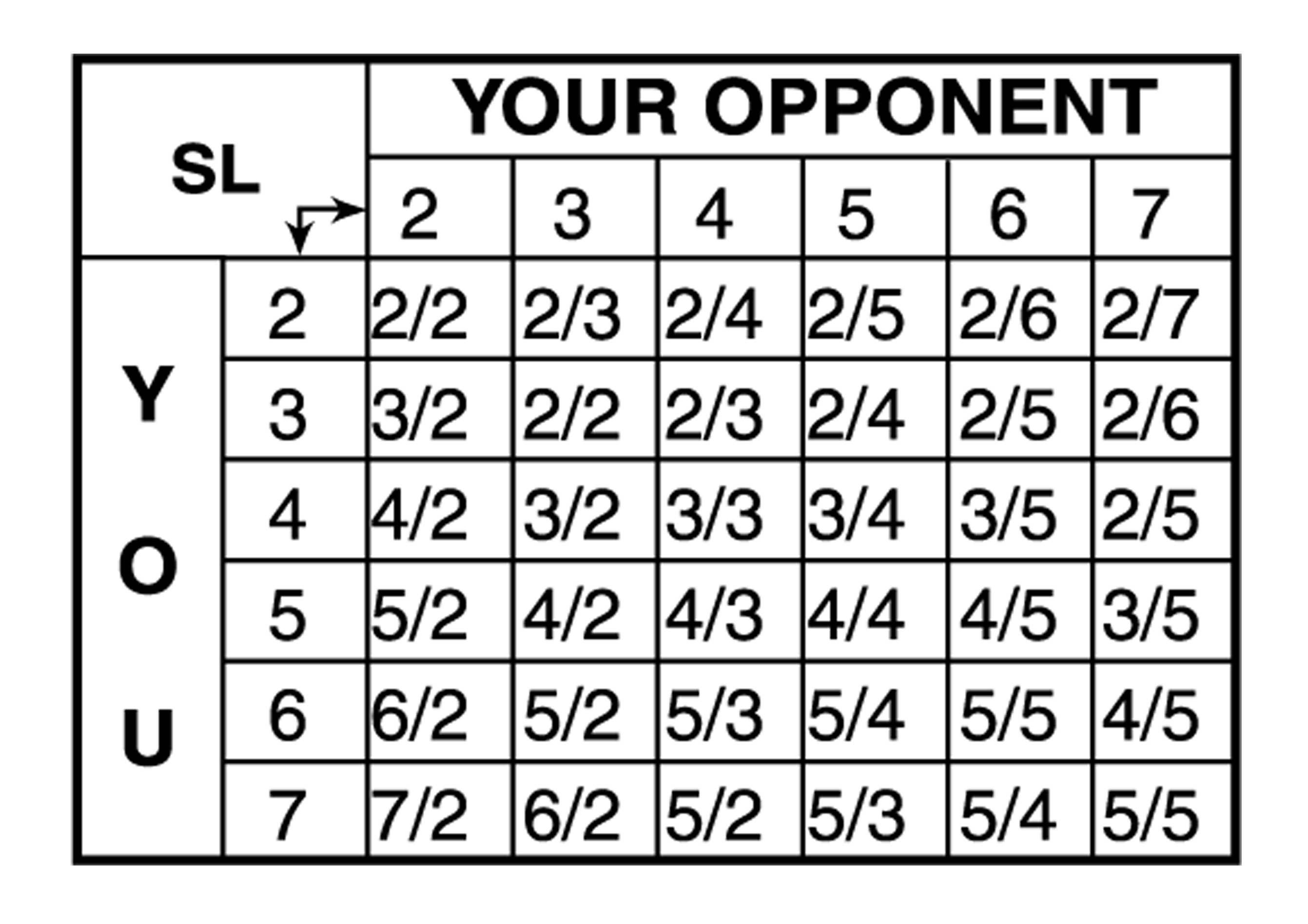
To read the chart, find your skill level along the left side. Then find your opponent’s skill level along the top of the chart. Now, track to the right from your skill level and down from your opponent’s until the two tracks meet. In that block the first number is the number you will race to, and the second is the number your opponent will race to. The two numbers involved should have the same differential as your skill levels do. For example, a SL6 playing a SL4 tracks to the block with 5/3 (circled) in it. The SL6 races to 5 games, while the SL4 races to 3. 5 to 3 is a differential of 2, just as 6 to 4 is a differential of 2. Example 1: Bill is scheduled to play Frank. Frank is a SL5. Bill just joined the League and is a nonrated player, meaning that he does not have a skill level yet. Therefore, Bill plays as a SL3 and Frank plays at his skill level, which is 5. Referring to the “Games Must Win” chart, you can see that in a match between a SL5 and a SL3 the SL5 player races to 4 and the nonrated player races to 2. That is the difference of 2 games, which is also the difference in the Skill Levels. Frank is going to have to win 4 games of 8-Ball before Bill wins 2. That is Bill’s advantage or equalizer. Example 2: In the fifth week of play, John, who is a SL6, and Mary, who is a SL3, are scheduled to play each other. Referring to the “Games Must Win” chart, you can see that a match between a SL6 and a SL3 has the SL6 player racing to 5 and the SL3 player racing to 2. That is the difference of 3 games, which is the difference in their skill levels. John is going to have to win 5 games of 8-Ball before Mary wins 2. That is Mary’s advantage or equalizer.
Using The Equalizer® in 9-Ball
How Handicaps Are Determined
How to Get Started
New players do not have a skill level established, so all new players will start as a skill level 3. Those who compete in 8-Ball will begin with their current 8-Ball rating. A League Operator is authorized to assign special skill levels and lowest attainables to new players who are known to be highly skilled players or to players who have previously established a skill level in another format. As a result of your first match, a skill level is established and reported for you. It is against the rules for a player who has an established skill level to attempt to reestablish his skill level at a later time. For example, you can’t quit for awhile and then rejoin the League or transfer to another League area as a nonrated player. You are obligated to disclose the fact that you are a former or current member in another League area with an established skill level.
Once Skill Levels Are Established
How to Use the Chart
To read the chart, find your skill level along the left column. Then find your “Points Required to Win” in the right column. To determine how many points your opponent needs to win, follow the same procedure using his/her skill level. Example 1: Mike is scheduled to play Chris. Chris is a SL5. Mike just joined the League and is a nonrated player, meaning that he does not have a skill level yet. Therefore, Mike plays as a SL4 and Chris plays at his skill level, which is 5. Referring to the “Points Required to Win” chart, you can see that in a match between a SL5 and a SL4 the SL5 player races to 38 points and the nonrated player races to 31 points. Chris is going to have to win 38 points before Mike wins 31 points. That is Mike’s advantage or equalizer. Read how you can keep your team from being disqualified at the World Pool Championships
| Player's Skill Level | Point Required to Win |
| 1 | 14 |
| 2 | 19 |
| 3 | 25 |
| 4 | 31 |
| 5 | 38 |
| 6 | 46 |
| 7 | 55 |
| 8 | 65 |
| 9 | 75 |
